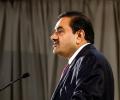
Adani Enterprises Ltd (AEL) reported an over sevenfold year-on-year (Y-o-Y) rise in its consolidated net profit, attributable to the owners of the company, for the January-March quarter of 2024-25 (Q4FY25) due to an exceptional item gain. The conglomerate's net profit was recorded at Rs 3,844.91 crore, up from Rs 450.58 crore a year ago.
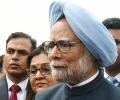
Condolences have poured in from across the globe, including from the United States, Canada and Sri Lanka following the demise of former Prime Minister Manmohan Singh.

Among the 30 Sensex companies, Larsen & Toubro, Power Grid, NTPC, State Bank of India, Reliance Industries and HDFC Bank were the biggest laggards. Sun Pharma and Nestle were the only gainers.

The maiden Africa India Key Maritime Engagement exercise will be held from April 13 to 18 off the coast of Dar es Salaam, Tanzania.
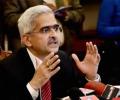
Reserve Bank Governor Shaktikanta Das has pitched for policy support from all sides -- fiscal, monetary and sectoral -- to nurture recovery of the economy hit by the second wave of the coronavirus pandemic. The dent on economic activity due to the second wave of the pandemic during April-May necessitated continuation of monetary measures to support the process of economic recovery to make it durable, Das had said while participating in the meeting of the Monetary Policy Committee (MPC) earlier in the month. "Overall, the second wave of COVID-19 has altered the near-term outlook, and policy support from all sides - fiscal, monetary and sectoral - is required to nurture recovery and expedite return to normalcy," Das said, as per the minutes of the meeting released on Friday.

India's foreign exchange reserves, now at $100.05 billion, is expected to reach $104 billion by March, but its high growth may slow down due to rising trade deficit, according to the Institute of Economic Growth.

International Monetary Fund (IMF) Deputy Managing Director (MD) Gita Gopinath has condemned the "terrible and disturbing" incident of rape and murder of a trainee doctor in Kolkata. "Personally, it is terrible to have any event of this kind. It is disturbing," she told Business Standard in New Delhi.

Economists have asked Finance Minister Arun Jaitley to lower interest rate, rationalise subsidies, remove all cess and surcharge, do away with the retrospective tax amendments and scrap dividend distribution tax to revive investment cycle and promote growth.

Nestle surged 4.25 per cent after the FMCG major reported 4.94 per cent increase in net profit at Rs 688.01 crore for the quarter ended December 31, 2024. IndusInd Bank, Titan, Tata Motors, Tata Steel, ITC and Maruti were the other major gainers. ITC Hotels, Bharti Airtel, Bajaj Finserv, Bajaj Finance and ICICI Bank were among the laggards.
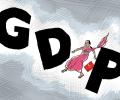
India's economy continues to be robust, but downside risks such as rising crude oil prices, adverse weather conditions, and the global banking crisis outweigh the upside potential in gross domestic product (GDP) growth in the current financial year (FY24), the finance ministry said on Tuesday in its Monthly Economic Review for March. "We reiterate that downside risks to our official forecast of 6.5 per cent for real GDP growth in FY24 dominate upside risks," the review said. "Opec's surprise production cut has seen oil prices rise in April, off their lows of low-seventies per barrel in March.

RBI's latest rate cut is positive for the economy.

Jammu and Kashmir Lt Governor Manoj Sinha assured the newly elected legislative assembly on Monday that the Omar Abdullah government will make all efforts for the restoration of full statehood and constitutional guarantees available to the state.
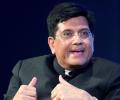
Piyush Goyal, who held the post of finance minister when Arun Jaitley was undergoing treatment, told the Confederation of Indian Industry's annual session: "All stakeholders, including the RBI, should introspect on their respective roles (on low economic growth)."

'As the global economy undergoes significant transformations in 2025, India's ability to navigate the complexities of trade wars, financial realignments, and emerging blocs will be pivotal,' explain Harsh V Pant and Soumya Bhowmik.
Government-estimated growth for 2008-09 is 7.1 per cent. However, as per RBI estimates, GDP growth would be around 6 per cent in 2009-10.
He speaking in New Delhi on the occasion of release of a copy of India's Rurural Infrastructure Report prepared by National Council for Applied Economic Research (NCAER).

During a three-hour long virtual meeting with CEOs of large public and private sector banks along with heads of NBFCs, the prime minister assured them that the government is ready to take all steps to support the financial sector.

Isn't there something significant in the UPI example for all of us to learn from and execute to enable world-scale success for our startups?, asks Ajit Balakrishnan.
Elections in nine states coupled with possible geo-political tension and rise in oil prices may prove to be a dampener for high economic growth.

Microsoft chairman and CEO Satya Nadella on Wednesday highlighted the importance of driving inclusivity and empowerment through technology and economic growth and asserted that the company is "very committed to India". He was speaking at Microsoft's Tech for Good and Education showcase, an event that highlighted the impact created by technology in the areas of philanthropic work and education. Nadella did a walk through, interacting with teachers, students and professionals who are making a difference in the society, by leveraging various Microsoft programs, initiatives and tools.

Dalal Street minnows stole the show in 2024, giving handsome returns to investors, helped by a largely optimistic trend in the stock market and impressive retail investors' participation. Analysts attributed the positive trend in the equity markets, where the benchmark indices shattered many records this year, to robust domestic liquidity, strong fundamentals of the Indian economy, and policy continuity.

Corporate earnings from blue-chips like HDFC Bank, ICICI Bank, Donald Trump's swearing-in as the US President, and trading activity of foreign investors are the key factors to drive equity markets this week, analysts said. Trump will be sworn in as the US president for a second term on Monday. This week, several key Nifty-50 companies, including BPCL, HDFC Bank, Hindustan Unilever, Dr Reddy's, UltraTech Cement, JSW Steel and ICICI Bank are scheduled to announce their financial results.

Equity markets this week will take cues from global trends, trading activity of foreign investors and quarterly earnings, with TCS kick-starting the results calendar on Thursday, analysts said.

'Entering India is exciting, but it's also challenging. You have to be prepared for long-term investment.'

He was most recently credited as one of the brains behind labour law reforms in Rajasthan

From the Sensex pack, Bajaj Finserv, Mahindra & Mahindra, Axis Bank, Bajaj Finance, Adani Ports, ICICI Bank, Zomato and UltraTech Cement were among the biggest gainers. However, ITC, Nestle, State Bank of India, Reliance Industries, Asian Paints and Tata Consultancy Services were among the laggards.

Moody's Ratings on Tuesday said India's growing water shortage can disrupt farm and industry sectors and is detrimental to the credit health of the sovereign as rising food inflation and decline in income may spark social unrest. It said decreases in water supply can disrupt agricultural production and industrial operations, resulting in inflation in food prices and hence can be detrimental to credit health of sectors that heavily consume water, such as coal power generators and steel-makers.

Indian equity markets have a limited upside potential in the near-term as they negotiate the ensuing cyclical slowdown, wrote analysts at Nomura in a recent coauthored report led by Saion Mukherjee, their managing director and head of equity research for India. He, however, believes that the foundations are in place for sustainable growth over the medium-to-long term, and hence suggests a 'buy on dips' strategy to equity investors. As an investment strategy, Nomura prefers domestic-oriented sectors and companies over exporters, and prefers stocks that provide valuation comfort. Industrials and banks are their overweight sectors, while IT services and consumer discretionary are their underweight sectors.

Several leading scientists, academicians, and agriculturalists have called for raising government support for research and development to make Indian agriculture future-ready.
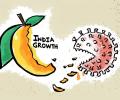
The Reserve Bank on Wednesday retained the GDP growth forecast at 9.5 per cent for the current fiscal but cautioned that the economic recovery is not yet strong enough to be self-sustaining and durable.

The paint sector is seeing heightened competition with the entry of deep-pocketed groups like Aditya Birla and JSW. However, some brokerages see an opportunity in select stocks.

All Sensex shares, except for Hindustan Unilever, ended with losses. Tata Steel fell the most by 7.33 per cent followed by Larsen & Toubro which cracked 5.78 per cent. Tata Motors, Kotak Mahindra Bank, Mahindra & Mahindra, Infosys, Axis Bank, ICICI Bank, HCL Technologies and HDFC Bank were the other big laggards. Hindustan Unilever ended marginally higher.
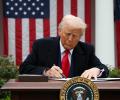
On India, the chart showed that the country charged 52 per cent tariffs on the US "including currency manipulation and trade barriers," and America will now charge India "discounted reciprocal tariffs" of 26 per cent.


President Droupadi Murmu on Wednesday emphasised the need to strengthen affirmative action as a tool for inclusion while urging the rejection of divisive tendencies rooted in perceived social hierarchies.

Speaking at a national workshop organised by National Institute of Electronics and Information Technology, Sibal said that major thrust to achieve such a growth rate has to come from the secondary and tertiary sectors.

The external environment has worsened further. While the Finnish economy entered into a recession, Swedish economic growth also dipped. The Finnish gross domestic product (GDP) dropped 0.6 per cent in October-December, 2022. It was the second quarter of negative growth, which is a technical definition of recession.

'We have not even used 0.1% of the available resources.'

The finance minister chided the central bank on Tuesday over its focus on fighting inflation, saying the Reserve Bank of India (RBI) also needed to abide by the government policy to promote economic growth.
